
What Is an Autonomous Vehicle Training Simulator?
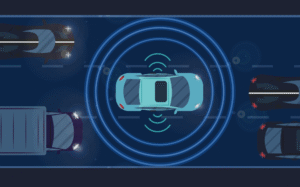
An autonomous vehicle training simulator is a computer-based application that provides the simulation of real-world conditions of a car in a computer simulation. It enables developers to simulate how a self-driving car will perceive its environment, make decisions and react to dynamic environments without using real cars and endangering human life.
Why Autonomous Vehicle Simulators Are Essential for Safe Testing
Testing self-driving cars in real traffic is risky, expensive and slow. Autonomous vehicles must handle unpredictable situations such as sudden pedestrian crossings, dense traffic and adverse weather conditions. These scenarios are difficult and unsafe to recreate repeatedly on public roads.
Autonomous vehicle training simulators deal with this issue by offering realistic virtual platforms on which engineers can safely test, validate and refine self-driving systems. These simulators speed up development and significantly reduce safety risks and testing costs.
Why Real-World Testing Alone Is Not Enough
Physical road testing requires test vehicles, safety drivers, controlled locations and significant time investment. More importantly, rare and dangerous situations such as emergency braking or unexpected road hazards cannot be safely reproduced at scale in real-world environments.
Simulation-based testing enables autonomous systems to be evaluated repeatedly under controlled conditions. This allows teams to test millions of scenarios efficiently, identify failures early and improve system reliability before deployment on public roads.Autonomous vehicle training simulators deal with this issue by offering realistic virtual platforms on which engineers can safely test, validate and refine self-driving systems. These simulators speed up development and significantly reduce safety risks and testing costs.
Core Capabilities
Testing self-driving cars in real traffic is risky, expensive and slow. Autonomous vehicles must handle unpredictable situations such as sudden pedestrian crossings, dense traffic and adverse weather conditions. These scenarios are difficult and unsafe to recreate repeatedly on public roads.
- Life like road conditions such as city streets, highways, crossroads and street lights.
- Weather fluctuations, changes in light, traffic flow etc.
- Virtual road users such as pedestrians and cyclists among other vehicles.
- Precise vehicle behavior in terms of steering, braking, accelerating and stability.
Simulators offer significant information about the performance of the system by being highly realistic to real driving situations.
How Simulation Helps Test Self-Driving Cars Safely
Realistic Self-Driving Car Simulation Scenarios
Simulators can recreate dangerous situations such as sudden obstacles, heavy rain, or unpredictable human behavior without real-world consequences. This enables engineers to stress-test autonomous systems under conditions that would be unsafe to reproduce on public roads.
Testing Perception and Decision-Making in Virtual Environments
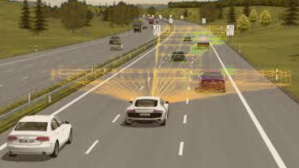
Inside the car, cameras and radars send real-time data to onboard computers, which learn by recognizing patterns. Instead of testing on actual roads, these systems are trained in digital environments where light, weather, and traffic appear lifelike. These simulated scenarios challenge the vehicle’s decision-making: would it brake, swerve, or wait?
When simulations feel realistic, people respond as they would in real life. This is to reveal issues that would not have been identified by normal testing hence engineers will correct the issues even before the car is even on the road.
Simulation-Based Testing of Autonomous Vehicles Without Real-World Risk
Simulation enables continuous testing and rapid iteration of AI algorithms. Developers can refine decision-making logic, analyze failure cases and improve system behavior well before real-world deployment. This significantly reduces accident risk and development time.
Key Benefits of Autonomous Vehicle Simulation Platforms
The simulation-based testing has become an inseparable part of the autonomous vehicle development.Key benefits include:
Faster Development Cycles
Virtual testing enables thousands of scenarios to be run faster without having to wait until real-world conditions arrive to speed up innovation and time to market.
Lower Testing Costs
Simulators let companies test self-driving systems without needing large fleets or expensive test tracks. That means faster development and lower costs.
Safe Testing of Edge Cases
Dangerous or rare situations can be replayed again and again in a virtual world. This helps engineers improve safety without risking people, vehicles, or legal issues.
Better AI Training
Simulated environments generate diverse data sets that improve AI learning, perception accuracy, and decision-making robustness.
Why Simulation Is Essential for Safe AV Deployment
Self-driving car simulators can eliminate the disconnect between the technical measures of safety and the actual human perception. Simulation systems like CARLA and BeamNG.tech enable developers to not only assess the technical requirements of a system, but also the behavior of the system itself to seem safe and natural.
This congruity in system verification and human understanding is essential to create trust in the public and facilitate the safe implementation of it in the real world.
Conclusion: Safer Autonomous Vehicles Through Simulation-Based Testing
Autonomous vehicle training simulators play a vital role in making self-driving cars safer, more reliable, and ready for real-world use. By enabling large-scale, risk-free testing of complex driving scenarios, simulators help developers validate AI systems, reduce costs, and accelerate innovation.
With the further development of autonomous driving technology, simulation-based testing will still be one of the starting blocks to safer roads and more reliable self-driving systems.
For more information please feel free to Contact Us