
Introduction
VR Training Simulators are growing landscape of digital transformation, as a breakthrough technology for developing real world skills in a safe, controlled, and highly engaging environment. By merging 3D visualization, real time interaction, and sensory immersion, VR simulators enable learners to practice difficult tasks without physical risk or resource limitation.
From aviation, medicine, and industrial maintenance, organizations worldwide are shifting from traditional classroom and computer based training towards simulation based education. This evolution reflects the growing demand for faster, more adaptive learning experiences that mirror real world scenarios without having any difficulty or drop in performance.
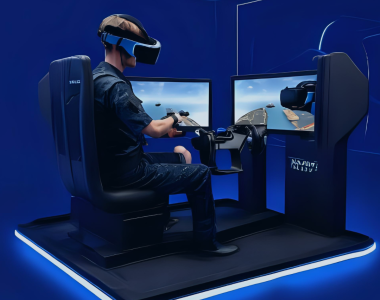
How VR Training Simulators Work?
Head-Mounted Display
Devices such as HTC Vive, or Varjo headsets provide high resolution 3D visualization and head tracking, allowing trainees to enter the real virtual world.
Input Devices
Controllers, haptic gloves, and motion sensors enable real time hand and body interactions within the simulation environment which feels real.
Tracking Systems
Electromagnetic sensors capture user movement and sync it with virtual elements to create realistic motion feedback.
Simulation Software
The core platform builds virtual environments, defines training modules, and records performance data. Unity and Unreal Engine are widely used frameworks for developing VR simulations.
Data Analytics & AI Integration
Advanced VR simulators use AI algorithms to access performance metrics, error, and learning curves, providing personalized feedback and adaptive training response.Through these systems, VR training simulators transform learning into experiential learning, where trainees gain hands-on experience through repeated virtual training and practice.
VR Training Simulator Advantages
Enhanced Method and Engagement
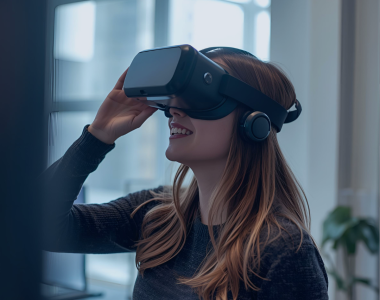
Captivative learning experiences stimulate multiple senses, resulting in higher knowledge retention rates. According to studies which show that trainees remember up to 75% of what they experience in VR compared to 10 to 20% from lectures or reading. Mistakes no longer carry consequences—they become valuable learning moments that help participants refine their skills and build confidence before applying them in real scenarios.
Safe Learning Environments
Industries which include aviation, firefighting, and healthcare they use VR to create realistic yet completely safe training spaces.These simulations let trainees handle challenging or risky situations without facing real world danger.
Cost Efficiency
Development costs may be higher but VR training reduces long term expenses by minimizing material usage, instructor hours, and travel costs linked with physical training.
Scalability and Standardization
When a VR training segment is developed, it can be shared and used anywhere in the world with the same content and evaluation standards.This ensures consistent training quality and performance results across all global locations.
Feedback and Analytics
Built in tracking systems and AI analytics capture detailed performance metrics reaction times, accuracy, and decision making processes enabling exact evaluation and improvement.
VR Training Simulator Across Industries
Aerospace
Pilots, maintenance engineers use VR simulators to practice flight operations and handle emergency situations in a safe environment. If compared to traditional flight simulators, VR offers greater flexibility, lower costs, and a much more immersive training experience.
Healthcare and Medicine
VR training is growing like surgical education and patient care. Surgeons can easily perform simulated operations, medical students can easily explore human anatomy in 3D, and nurses can practice emergency procedures repeatedly without any real risk.
Manufacturing and Industrial Operations
Engineers use VR simulation training for equipment assembly, maintenance, and safety procedures.These simulations allow workers to practice difficult mechanical tasks or perform emergency shutdown drills in a virtual environment before entering the real factory floor.
Energy and Construction
In oil, gas, and construction sectors, VR training ensures compliance with safety standards by simulating dangerous conditions such as heavy machinery operation, and high altitude tasks.
Corporate and Soft Skills Training
In technical skills, VR is increasingly used for leadership, communication, and development. These engaging environments can recreate customer interactions or team management scenarios, helping participants strengthen their decision making abilities and emotional intelligence.
VR Training Simulator Technological Components
Graphics Engines
Unreal Engine creates real environments with physics based rendering.
Artificial Intelligence
AI personalizes training components by checking the adapting difficulty levels based on learner performance and capability.
Cloud Infrastructure
Enables centralized data storage, remote access, and multi user simulations across global teams.
Internet of Things
Integrates physical sensors with virtual models for hybrid simulations. For example combining real equipment with virtual overlays.
Haptics Motion Platforms
This Deliver tactical feedback and motion cues to simulate touch, pressure, or vibration, enhancing realism.
Challenges
VR training simulators challenges:
High Primary Investment
Creating custom VR environments requires special software and 3D modeling expertise.
Hardware
High quality Virtual Reality requires advanced GPUs, accurate tracking, and low latency rendering to prevent motion sickness.
User Adaptation
Some trainees experience uncomfortable situations during extended VR session user onboarding and ergonomics remain crucial.
Content Updates
Keeping simulations up to date with evolving real world procedures demands continuous maintenance.
VR Training Simulator In Future
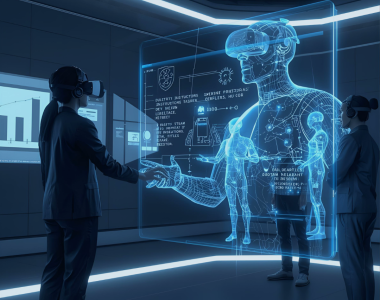
The next coming Era will witness AI driven, data adaptive, and cloud connected VR training ecosystems. Linked with Augmented Reality (AR) and Mixed Reality (MR) platforms capable of blending virtual and real world learning experiences.
AI Performance Coaches
Real time AI virtual assistants guiding trainees during their simulations.
Multi-User Collaboration
Shared VR spaces for team based training and global remote learning.
Digital Twins
Integration with IOT and 3D modeling to represent real world equipment and facilities for training.
Conclusion
VR training simulators represent how humans learn complex skills. By combining immersive visualization, real time feedback, and adaptive intelligence, they transcend the limitations of traditional and computer based learning. From industrial safety to medical surgery, VR offers a universal platform where experience replaces explanation. As technology matures, organizations investing in VR simulation today are growing their training efficiency and they are also shaping the future of human performance. Contact Zatsim to build your VR training solution